

"Not how much, but how."
In 1958 Mila opened her first Atelier in Via San Pietro all’Orto, Milan.
In 1965, at Giovanni Giorgini’s invitation, she presented her collection at Florence’s Palazzo Pitti in twenty-five different variations of violet, from lilac and mauve to wisteria which stirred enthusiasm and appreciation from the press and international buyers.
The year 1966 saw Mila receive the “Oscar of Fashion” from Neiman Marcus which was her first trip to the US. The same year at Gran Galà in New York, Lee Radziwill and Marella Agnelli, who adorned her designs were given first and third places in the Women’s Wear Daily poll for the best-dressed list.
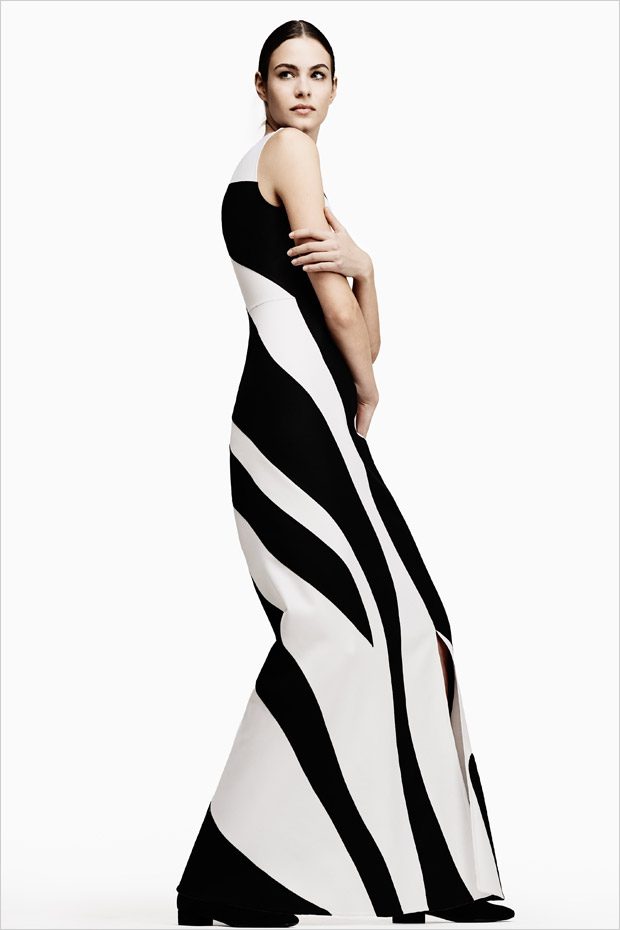
She also opened her new atelier in Via Montenapoleone in Milan, designed by architect François Catroux In late 1960s Mila started a new revolution with the creation of ‘the double-faced fabric’ made by meticulous workmanship and an absolute innovation.In the year 1969, Mila Schön’s collection inspired by Calder was awarded “Tiberio d’oro” in Capri, Italy. The same year she created the famous ‘long-dress with Fontana-style slashes’ inspired by Lucio Fontana’s art which was photographed by Ugo Mulas. It was around this year that Mila began to construct a complete image with exclusive accessories creating a total look, eventually including handbags and shoes, lingerie and watches, perfume, swimwear and eye wear. She also designed the made-to-measure uniform for Alitalia flight crew. Mila Schön became a renowned name during the end of 1960s and was one of the most successful couturiers of the day and many show women turned to her for clothes for their performances.
In 1971, came one of Mila’s biggest successes. The birth of menswear line Mila Schön U, along with double-faced neckties became one of the best sellers of the brand. Same year she also presented the brand’s first prêt-à–porter collection for women.In 1973 Mila Schön became one of the first fashion houses to represent the ‘made-in-Italy’ in Japan.
In the year 1983, 25 years of Mila Schön was celebrated with a collection of High Fashion historical and contemporary pieces at Ninfeo of Valle Giulia in Rome.In 1986, the Japanese multinational corporation Itochu invested in the registered stock of the company and in 1993 bought its entire parcel of shares. Despite this, Itochu’s role has always been only financial, with the creative and managerial side of the business in the hands of its founder. Later on, Itochu licensed the brand to the Mariella Burani Fashion Group.The year 1992 marked the house’s first Haute Couture Show in Paris.By 1995, the house decided to give up on haute couture and concentrate exclusively on ready-to-wear.n 1998, the label adopted a new strategy and handed over its lines to a style studio founded by eight young creators, who were all bred and trained in-house at Central St Martin’s and the Royal College of Art in London: Cristina Barreto, Lisa Cameron, Stefano Citron, Greg Myler, Federico Piaggi, Darryl Rodriguez, Paolo Trillini and Steven Verno, each an expert in their own field.
In the year 2002 Marc Helmuth, who had more than a decade experience in Dior, as well as stints at Thierry Mugler, Yves Saint Laurent and Lanvin was chosen as the new designer. He presented his first Mila Schön collection for Spring/Summer 2003.In 2007 the brand was acquired by Italian company Brand Extension that re-launched it with new collections designed by Bianca Maria Gervasio.
In September 2008, Mila Schön passed away at the age of 91. The year also marked 50 years of brand Mila Schön. AltaRoma celebrated the occasion by releasing a docufilm ‘50 Mila Schön’.

Ugo Mulas book on Mila Schon.

Mila Schon in the showroom at Via Montenapoleone 2 Milano Italy.



Mila Schon boutique in Rome.

Publicity shots for America.

Mila Schon in New York to receive her Neiman Marcus Award in 1966

Mila Schon greeting customers after a fashion show. at Palazzo Pitti in Florence.
Maria Carmen Nutrizio was born on September 28 1915 in Tau-Dalmatia (now Croatia.
She was from a aristocratic family that moved to Trieste in Italy when the Communist took over Yugoslavia after the First World War. She grew up in Trieste and moved to Milan in 1946 where she married Aurelio Schon. He was a fashionable jeweler and they had a luxurious life style .She was a couture client of Balenciaga as well as Dior. In 1958 after her marriage broke up she had to take care of her son Giorgio ,and started copying French fashions and selling them to friends in Milan .The company grew rapidly as she developed her own style and in 1966 she moved to Via Montenapoleone 2 - the most elegant street in Milan. She redesigned the old palazzo with Andre Catroux in a ultra modern fashion with furniture by Eero Saarinen ( that designed the Arches in St Louis as well as the TWA terminal at JFK Airport) and Joe Columbo.

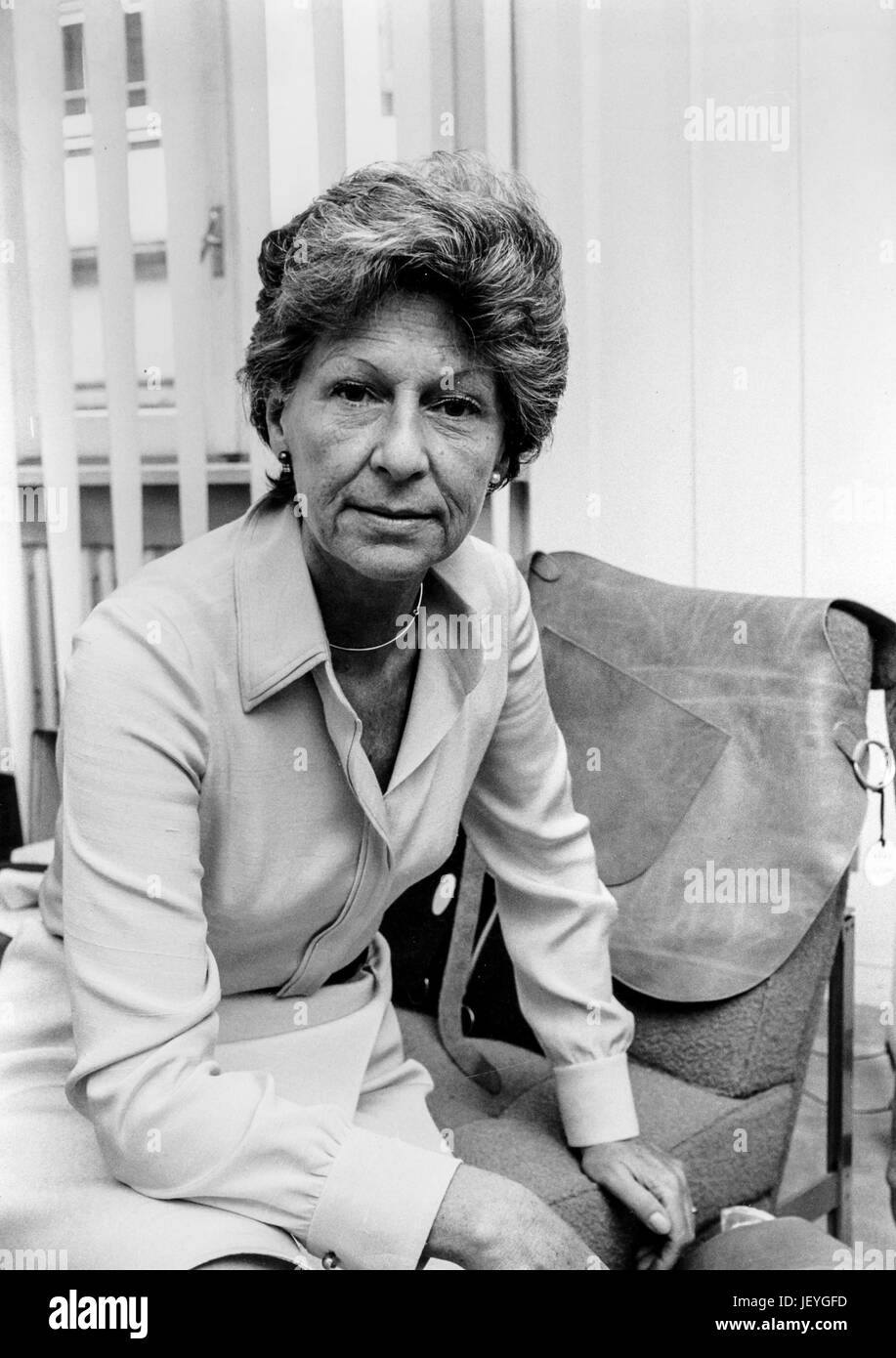
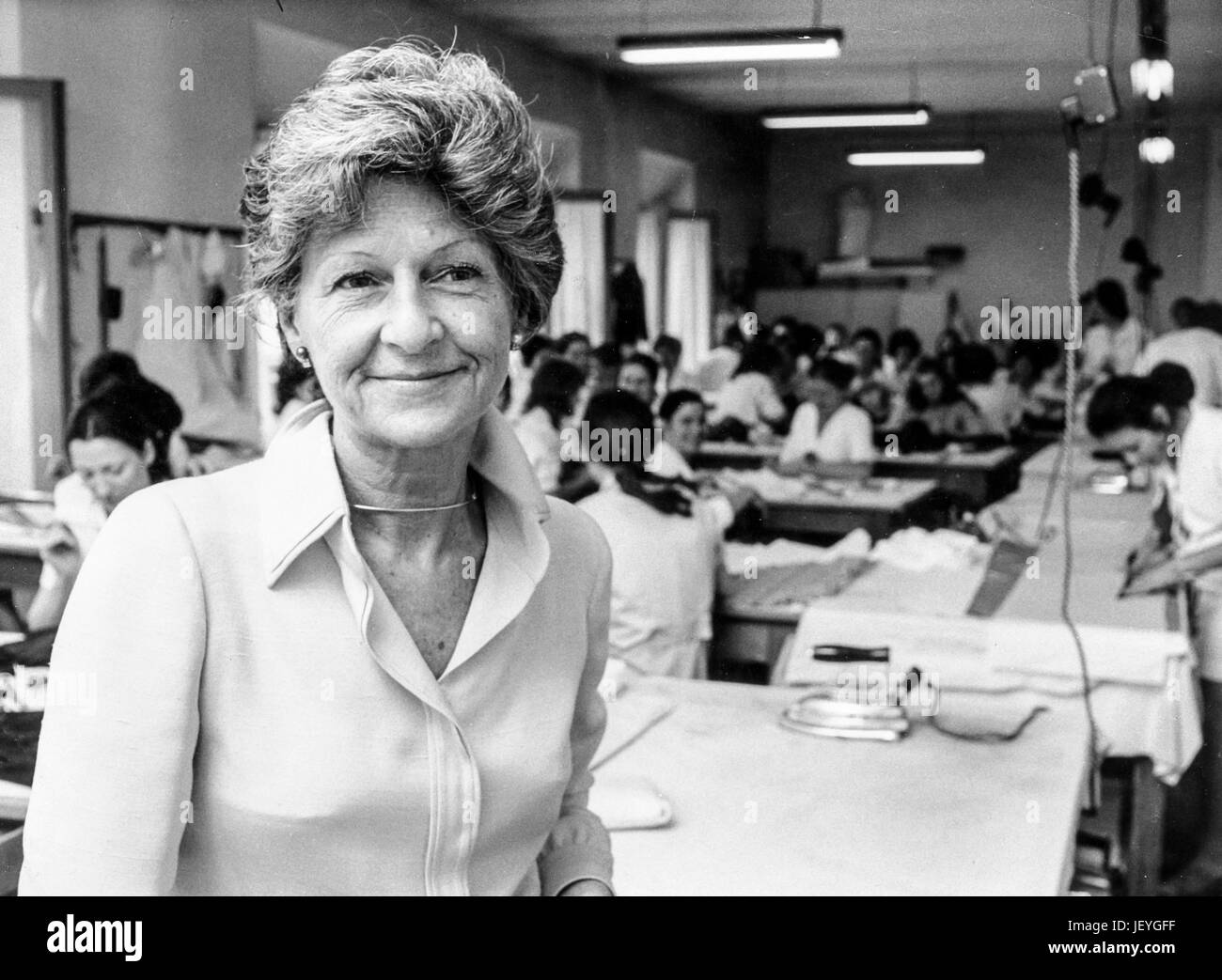


Mila Schon supervising a customer's fitting.

Double Face Wool Coat
Double Faced Wool become her trade mark .






 | ||||||||||
 |

Benedetta Barzini wearing Mila Schon.


Mila Schon's creation photographed by South African photographer Barry Lategan .
Italian Vogue 1970.


Alitalia Uniforms .

Mila Schon with singer Mina.


Mila Schon. Via Condotti. Rome.


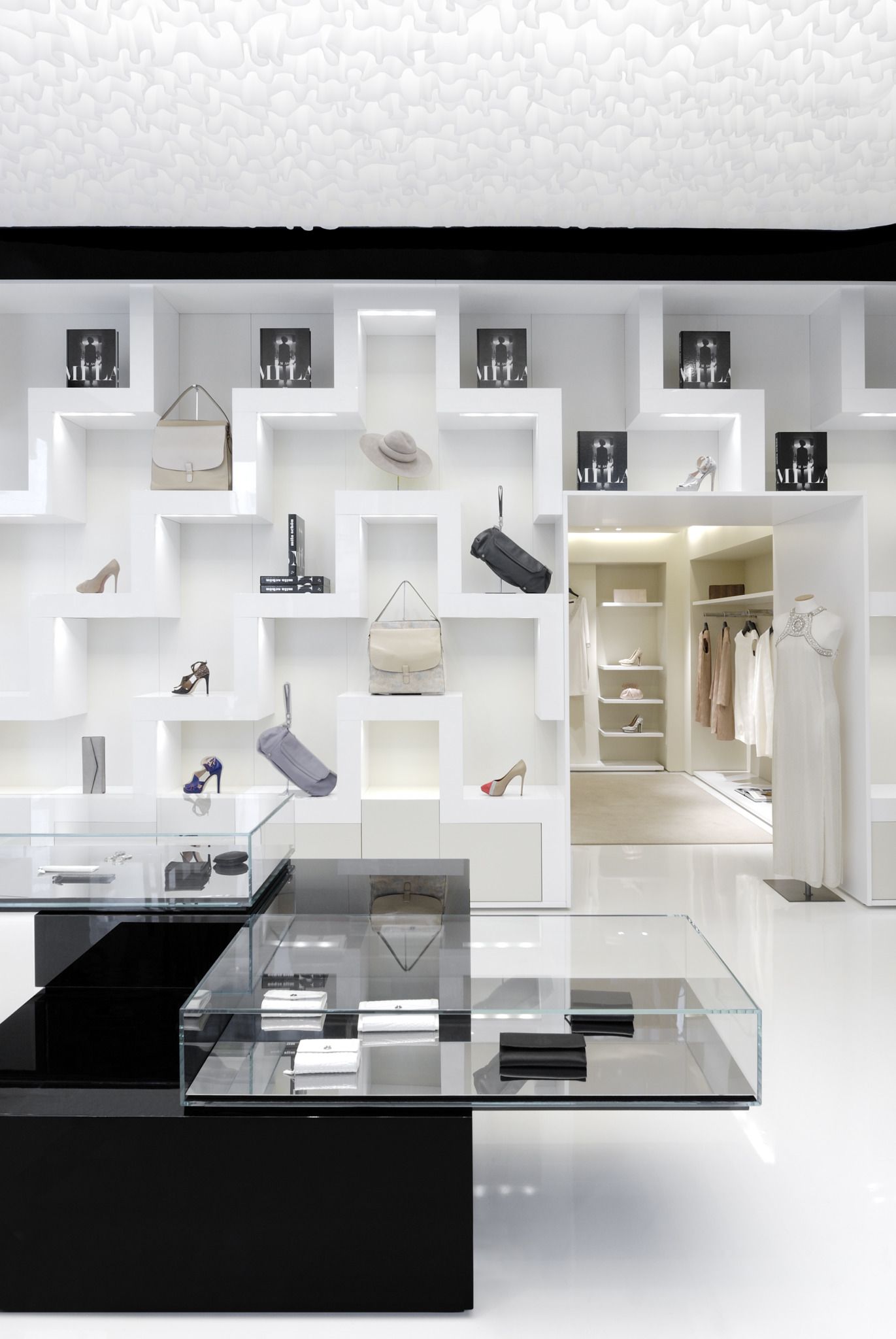
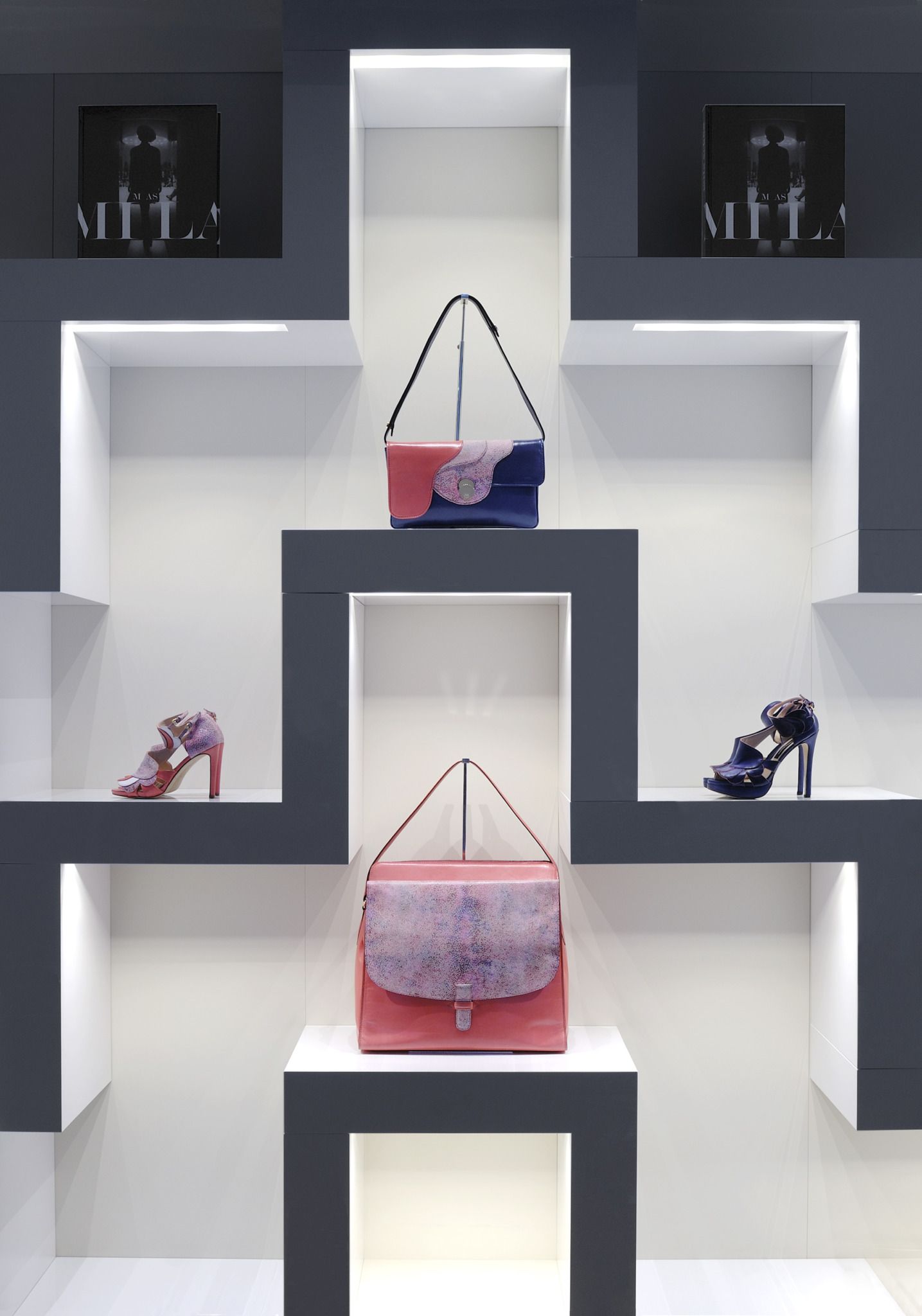
Mila Schon retail shops.

For the following series MILA SCHON supplied VOGUE and HARPER'S BAZAAR with the insets they added into their magazines. It s consisted of rice paper printed with her fashions so the page showed through.A unique concept and never done before or after.


Mila Schon photographed by Barry Lategan.


Veruschka wearing Mila Schon.


Marisa Berenson in Mila Schon.


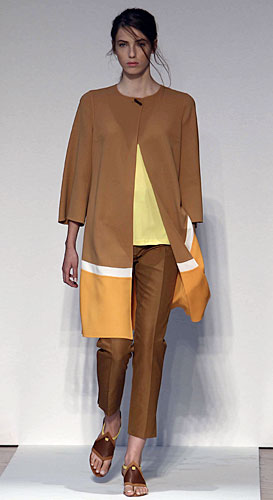

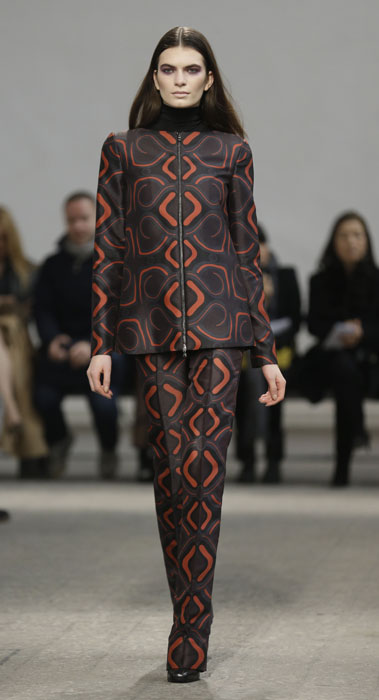

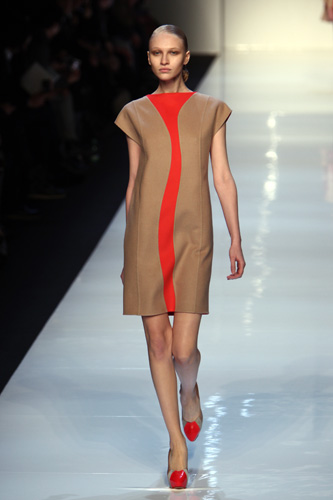


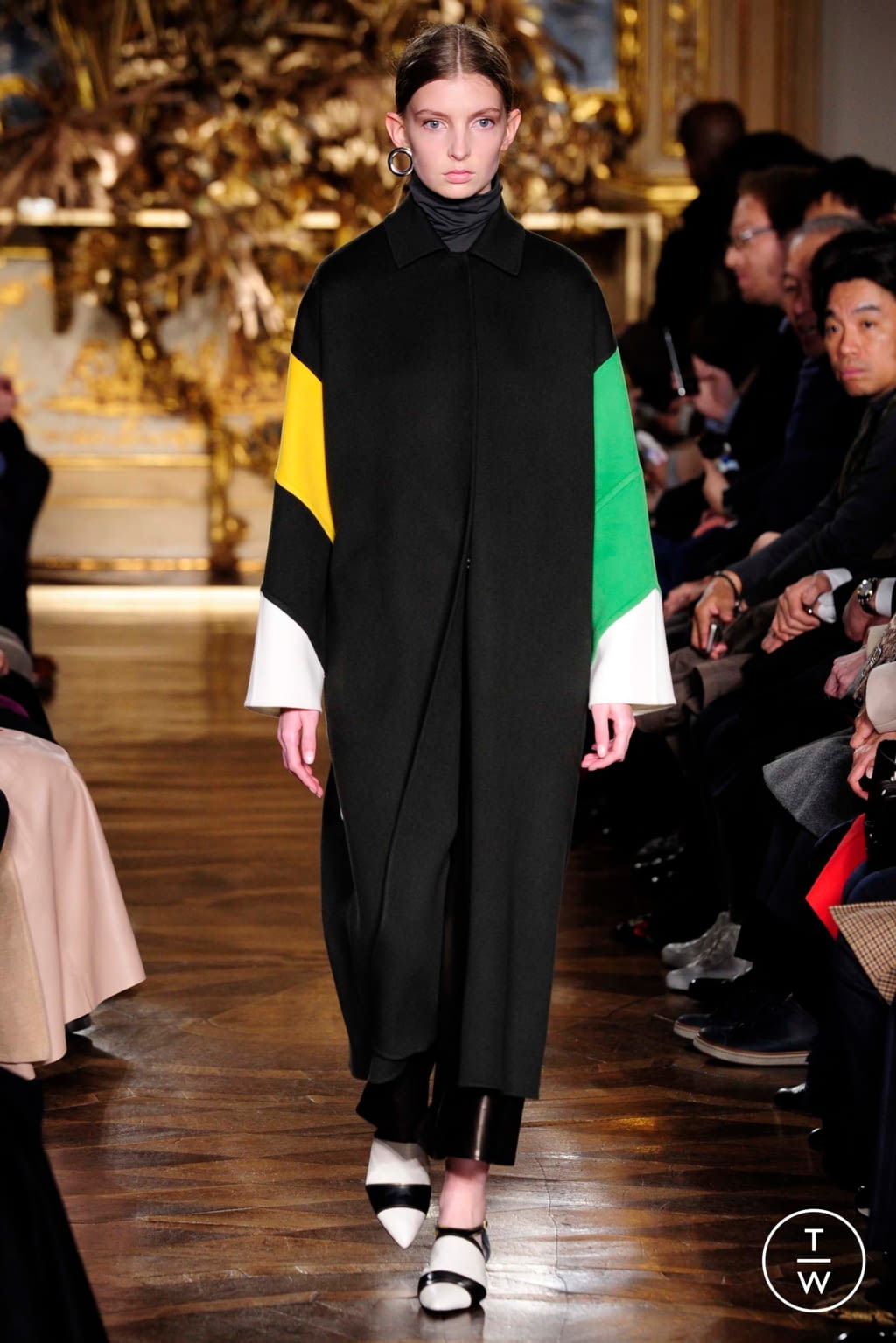


Lady Gaga wearing Mila Schon.

Soon the international press was calling Mila Schon the Chanel of Italy as well as the female Courreges.

Mila Schon and her son Giorgio.


Loris Abate and Mila Schon.


Mila Schon Japanese promotion.


Jackie Onassis wearing a Mila Schon print.
Her first famous customer was Marella Agnelli wife of the owner of Fiat. Soon the jet set started to buy her clothes .On the 28 of November 1966 Truman Capote gave his famous "Black and White" ball at the Plaza Hotel in New York. Marella Agnelli was voted the best dressed in a beaded sheer Mila Schon caftan . Princess Lee Radziwill ,Jacqueline Onassis' s sister ,was placed third in a Mila Schon sheath.

Marella Agnelli wearing Mila Schon.

Lee Radziwell in Mila Schon with Truman Capote .


Princess Lee Radziwill in Mila Schon.

Original sketches for Lee Radziwill.

Mila Schon with her beaded dresses.

Beaded detail on a Mila Schon gown.


Renato Balestra - Mila Schon- Gianni Versaci.

Milan 1985.
Laura Biagotti, Mario Valentino, Gianni Versace, Krizia ,Paula Fendi, Valentino , Gianfranco Ferre Mila Schon, Giorgio Armani, Ottavio Missoni, Franco Maschino, Luciano Soprani.
----------------------------
As Mrs. Onassis- Jackie Kennedy became one of Mila Schon's best customers .We even had a dress form made to her measurements in the workroom in Milan .She would view the collection in New York and the clothes would be made for her to fit the dress form .I remember Signora showing me a telegram from Mrs. Onassis -thanking her for the clothes, and how well they fitted.

Jackie Onassis (with Bunny Mellon) wearing Mila Schon.


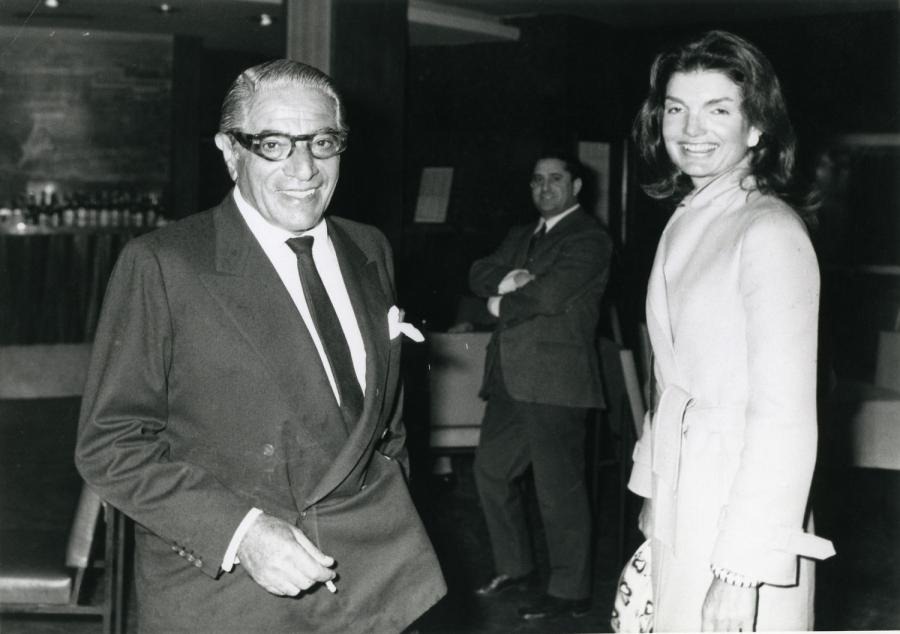
Jackie Onassis wearing Mila Schon .


Mila Schon was famous for her double wool dress and coat ensembles.
Mrs. Onassis wore them very often.

Jacqueline Onassis wearing a blue dress and coat by Mila Schon.


Window pane coat by Mila Schon.


Soon Mila Schon added a men's wear collection as well as shoes, handbags sunglasses to her collection. She also started her selling her clothes in Japan the first Italian designer to do so .Her clothes were also available at Neiman Marcus, Henri Bendel, Bergdorf Goodman and Saks Fifth Avenue in the USA.


Into this magical world of high fashion elegance I found myself the first day as I walked through the doors of Montenapoleone 2 . A 23 year old unsophisticated Afrikaans kid from Southern Africa. What was I letting myself in for? Fools rush in where angels fear to tread -so I just kept going.
I remember the smell of perfume and the very modern showroom on ground level that was the ready-to-wear boutique. All very luxurious .The sales women in there were dressed in purple or brown silk blouses, 3/4 wrap wool skirts and knee high boots. Everything matched .The colors they wore changed with every new season. The girls with long hair wore it is a chic chignon and those with short hair had it cut in a Vidal Sassoon bob. . Mila Schon's stamp was on everything you saw. Elegant understated chic and very modern .

Vidal Sassoon bob.
In my best Italian I asked the sales woman where I would find the design studio. In perfect English she directed me into the old palazzo .Everything was white with very modern chrome furniture .I was taken to a small office over looking the red rooftops of Milan. It had a very modern desk, chrome chair and lamp and very little else. As I was there at 10:00 am .Signora Schon was not expected until later so I sat and waited. After about an hour a secretary fetched me and took me into the design studio to meet Signora.She was dressed in a saffron yellow silk blouse with a saffron yellow summer wool wrap skirt- and a beautiful black crocodile belt- the buckle a silver M -around her waist. She was not very tall but very elegant and trim and healthy looking with little make up. Her hair was cut short and grey. She was about 56 year old. She had a black pearl in one ear and a white pearl in the other ear .A big diamond ring was on the little finger of her left hand-all set in platinum. She wore flesh colored hose and elegant leather pumps in crocodile leather with a low heel. So simple but oh so very elegant .I will never forget that. Her English was almost non existing and I had to communicate in Italian with her. Her secretary helped as she could speak English very well .She became the main go between us when we met.
Here one can see the black and white pearl earring she always wore.
Black on the right ear and the white one on the left ear.

Mila Schon in her home.

Mila Schon coat with Lucio Fontana painting.


Signora took me into a back room where the samples were kept- and told me to spend some time there looking at all the clothes. She wanted me to see what her "look " was so I had to study every garment and detail. She said everything that I design -must have the Mila Schon "look"-"Mila Schon -non Enrico" I was called Enrico -the Italian version of my name.After she left I did not know where to start. The clothes were magnificent .Very simple and clean cut but the fabrics were of the best quality .I have never felt wools and silk like that .Very simple cut gowns in tulle with every hole in the tulle covered with a bead. I was in heaven and started to work my way through the collection. The must have been 300 outfits. The gowns in those day were around $10,000.00 and one could see why. Slowly the Mila Schon "look" became clear to me.
In the beginning I would arrive in the morning to find a sample of fabric on my desk with instructions to design coats or suits for this fabric. I would spend the whole day sketching an every evening the sketches were taken to Signora .She would choose the ones she liked at the that moment, but the rest were filed away for later use. I never saw her discard one sketch. The next morning a clear desk with a stack of white sketch paper and pencils waited for me! New ideas -new ideas -that is what I was there for.....Some days I would be asked to design stocking, belts, handbags or even scarves...never in color just designs .Once she told me to use the M for inspiration. Most of her skirts in the collection were wrap skirts ,so when a woman sat down and crossed her legs, the skirt would fall away and expose her leg above the knee .I designed stockings with her motto M woven into the stocking placed above the knee as well one on each ankle. She loved that.

Another time I confused the word "capotto"(that means coat in Italian) when she used the word "mantello"- that could mean a coat or a cape. Not to make a fool of myself I sketched some coats with a cape affect over the shoulders that she loved as well. I sat in this little office and many times I looked out over the rooftops of Milan praying for inspiration! There were no fashion books around to inspire you. Every design had to be original. As this was all I was asked to do for weeks on end. It opened my eyes to everything around me .One looked at buildings, trees, flowers with different eyes seeking a a new line ,or a design idea. Even those red roof tops inspired me! It really taught me to see design and line in everything.

A couture house has two sections -the tailored area where the day wear is manufactured and the softer division where the dresses and evening wear was made. Some men work as tailors in the suits and coat area ,but women mostly worked on the gowns and softer fabrics. They sat at long table. Each garment was covered with a cotton sheet and only the piece that is been worked on is exposed. Almost everything was stitched by hand in the dress section.

Inspiration for the century - Prada - David Hicks Interiors - Mila Schon.


When a private customer was fitted- the dress division would first go and fit the dress or blouse. After they are done the tailors will come and fit the jacket or coat. This is all done under the eyes of the directrice of the house. She ran the workroom. Signora would only appear if it was a very important customer or to give the final outfit the once over.
I was not allowed to disturb the work room and was kept out of there. It was the inner sanctuary. I found it rather frustrating as I wanted to learn all that went on in all the levels of a top European Couture House. While I worked in the clothing factory in Cape Town I was part of every section -Designing, pattern making, the manufacturing side as well as the selling . Here I was confided to my little office sketching and sketching -8 hours a day producing new ideas. I had to get use to the idea of specializing in a field that was the way companies were run in Europe and America as well.

Mila Schon workers on strike.
I remember an occasion when I did see more of the work rooms. A few weeks before the Alta Moda Collection (High Fashion -the same as the French Couture Collection) ) was to be shown in Rome the workers union called out a strike. For an hour the workers would work, and for the next one hour they will get out their whistles, and walk around the palazzo blowing their whistles and scream slogans. After the hour of fresh air they will be back to work for an hour- before the left to walk around for the next hour. This went on for weeks and the show date was getting closer and closer. During this time all of us were allowed in the work rooms to help wherever we could. A handful of loyal workers did not leave and stayed on and even worked late into the night to make sure all the garments were ready when the collection had to leave for Rome.


Every know and then I would be called in to Signora's office when the men's division wanted me to fit a coat or jacket- and the model was not available. I dreamed of the day that I could afford clothes of that quality and fit. The first men's collection was shown in 1971
--------------------------------------


September 29 2008 -
Mila Schon Retrospective opened three weeks before her death at 93 in the Palazzo Reale.
Milano. Italy.

--------------------------------------
September 29 2008 -
Mila Schon Retrospective opened three weeks before her death at 93 in the Palazzo Reale.
Milano. Italy.


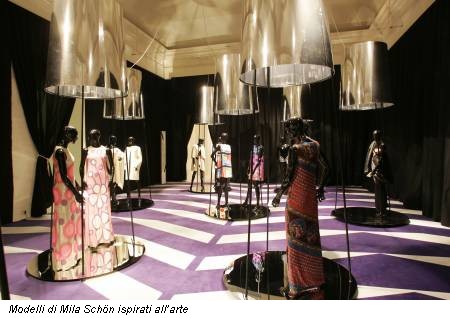


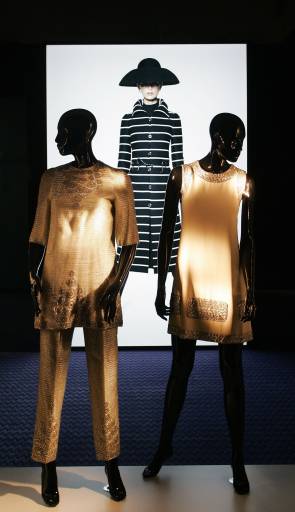
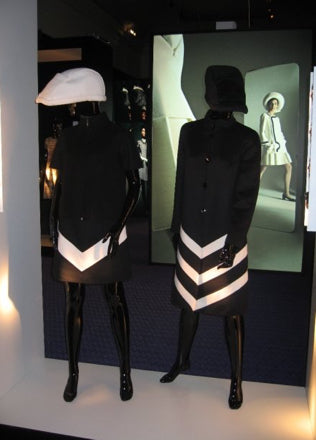
-------------------------------------------------------------
Mila Schon September 28, 1915- September 5, 2008


Mila Schon's funeral in Milano.

Giorgio Schon at his mother's funeral.
Obituary:- THE GUARDIAN September 12 2008
The life of Mila Schön, who has died aged 91, was a familiar plot in comedies and musicals in the 1930s: a woman born into old-world wealth and fashion who loses everything to catastrophe, but pluckily sets up her own boutique, or even couture house, and succeeds. Cue a magnificent mannequin parade as a finale.
There was more than one disaster in Schön's story, but she made of them an enduring success, dying only days before her adopted city of Milan staged that fabulous finale, a tribute to her 50-year career. She was born Maria Carmen Nutrizio (the date is disputed) in Dalmatia to prosperous landowners of the Austro-Hungarian empire. But after the first world war, the lands ruled from Vienna were redistributed and the family started its slow impoverishment in Trieste, descending further in Genoa, where her father managed a chemist's shop
She repaired her fortunes during the second world war with a marriage to Aurelio Schön, an Austrian precious metals dealer, whom she met in Milan. Postwar, the couple were rich enough for Signora Schön, clad in furs, to take the night train or an automobile to Paris for her couture fittings at Balenciaga, and then Dior. She was as interested, if not more so, in the ateliers' construction techniques, especially Balenciaga's cut, than in the finished ensembles.
When her husband's jewellery business failed and the marriage expired, she was left broke, a divorcee with a young son. No more couture unless she made it herself. So she did, with the help of skilled Milanese seamstresses. Then her friends wanted what she had, Paris copies at Milan prices, and she and her mother opened a workshop in 1958 to supply them. It was a classic dressmaking apprenticeship, copying the best until the pupil has the confidence to be original.
By 1965, Mila - from a childhood nickname - Schön had advanced so far beyond imitation that she was invited to show her collection among the big names at the Pitti Palace in Florence. She edited her entry (ruthless editing remained the greatest of her reticent strengths to the end) to 25 outfits in tints and tones of violet, from wisteria to papal purple, and the colour of the Art Nouveau revival. The New York Times later called her "the shrinking violet of Italian couture". Subdued viola would have been more accurate. She arrested everybody's attention, and enjoyed enough financial backing to open her own house in 1966 in an antique palazzo on Via Montenapoleone, with modern furniture by Joe Colombo and Eero Saarinen: a very Schön juxtaposition.
Schön created clothes with intelligence but without grandeur or hauteur. Marella Agnelli, wife of the Fiat supremo Gianni Agnelli, was voted the best-dressed guest at Truman's Capote's 1966 black-and-white ball in a caftan embroidered by Schön's craftswomen, sheer and spare where its Parisian equivalent would have been solid and opulent. The third in the best-dressed guest contest was Lee Radziwill in a Schön shift, trickled with rivulets of sequins. Radziwill's sister Jackie Kennedy also took to Schön, especially in her Onassis yacht going years, as did Farah Diba, wife of the Shah of Iran, and later Imelda Marcos.
With that level of visibility among the beautiful people, Schön was discreetly hot. Stanley Marcus of Neiman Marcus presented her collections in Dallas and Houston in 1967; Bonwit Teller and Henri Bendel also stocked her in the US; she was the first Italian designer to show ready-to-wear in Japan, where the rigour of her geometry is still respected. She was called the feminine Courrèges for those angles and her (now slightly archaic) futurism, and was the logical choice to design uniforms for Alitalia in 1969, Iran Air in 1972, the Italian national team at the 1992 Barcelona Olympics and one of the Milan soccer teams in their suaver moments. All the fashionista characters and corpses in Emilio Miraglia's 1972 horror film La Dama Rossa Uccide Sette Volte (The Red Queen Kills Seven Times) wore Schön; the actors and their shoes have dated, but none of the clever costumes.
"Not how much, but how," was Schön's maxim, since she never lost her childhood curiosity about the assembly of a garment, nor her belief that she could do it more simply, more elegantly. Like Armani, she wanted to demolish the traditional structures of tailoring, although unlike Armani, she did not go soft. She experimented with doublefaced fabrics (investing in her own Cuomo textile firm for research and development), or made duplicate inner and outer shells, sewn together at the edges, for coats of "order and cleanliness" that did not plunge inside into a slum of lining and facing.
Schön remembered from childhood Jeanne Lanvin's feminine discipline, and she anticipated Jil Sander as an unsentimental reductionist. When she did do colour and pattern, she borrowed from the modern art she collected - Victor Vasarely, Kenneth Noland, Alexander Calder, Lucio Fontana.
Her approach to business was straightforward. She had no interest in the mass market, and when any line did too well and threatened to unbalance her financial harmony, she awarded it a separate sub-company. During her semi-retirement in the 1980s, her companies lost coherence and she sold the business in 1993 to the Japanese firm Itochu, which brought in a team from the Krizia label, encouraged Schön's return as overall supervisor, and opened new shops.
Mariella Burani's fashion group licensed the brand from 1999 to 2007, and sold it last year to Brand Extension, which recruited Bianca Maria Gervasio to design. Schön vetted output until her last months. Gervasio's next collection shows later this month, and that third-act parade honouring Schön's success - called Lines, Colours, Textures - opens at the Piazza Reale, Milan, next week.
Her son Giorgio survives her.
· Mila (Maria Carmen) Schön, fashion designer, born 1917; died September 4 2008


