Sunday, January 31, 2016

Camp Jabulani .Hoedspruit South Africa.


Camp Jabulani.


Lente Roode with one of the endangered cheetahs at the Hoedspruit Center in South Africa.


Adine and Lente Roode.

 Lente Roode and her daughter Adine manages and operate Camp Jabulani at the Kampala Game Reserve in South Africa.They also diversified their portfolio to include the Hoedspruit  Center for Endangered species The Hoedspruit Endangered Species Center is one of the leading private research and breeding facilities in the South Africa.. The center developed from a cheetah breeding project established by Lente Roode in the late 1980s to a world-renowned research and breeding establishment for various endangered species.
Great care is taken to ensure suitable breeding environments for the animals and cheetah, king cheetah, wild dog, black-footed cat and African wild cat have been bred successfully. The center aims to make an important contribution to the conservation of Africa's endangered wildlife and also offers educational programs for school children and a three-week conservation course for students.The center provides sanctuary to numerous orphaned, abandoned and sick animals. including Rhinos. Internationally renowned, it is often approached by animal rights organizations to assist in the rescuing and evacuation of animals in need.The center operates as a non-profit organization and relies on donations and sponsorship to maintain the various programs.


Allen and Heidi Roberts.

Our company TOSCA NEW YORK supports the non profit organization started by Allen and Heidi Roberts here in New York to assist Lente Roode in her endeavor to help the endangered species of the world. I was very graciously invited to visited the center and Camp Jabulani in January of 2016.


The beautifully decorated visitor Center at Camp Jabulani. Chairs covered in Zebra skin and thatched roofs with animal skin rugs on the floors ,make these interior truly African.. Bead-work done by the local population are used in a very original way.The elephant theme is seen in almost every detail.


Breakfast, lunch and dinner were served in the very comfortable dining room or could be enjoyed on the terrace.The food was outstanding - African, as well as international dishes were served by the very competent chef and staff. The service was very personable and friendly, and every whim was catered to.Our chef came to the table to explained the menu and if it was a unknown African dish, he explained it so that one could make an informed decision.It was sometimes difficult to remember that we were in the middle of Africa


Luxurious chalets at  Camp Jabulani.


Bed with mosquito net- and an outside shower at the back.


 View from the bed over the deck and pool -and into the dry river bed.
South Africa was going through a bad drought at the time, so the river was dry.


 Interior of the  luxury chalet with a writing desk and comfortable day beds on the deck outside.


At the Hoedspruit Center for Endangered Species one can see the animals taken being care of .
Baby rhinos who were found with their murdered mothers -killed for their horns- are taken care of here and the new "mother" is a sheep.


Lente and staff with a cheetah at the Hoedspruit Center.


 The Kampala Game Reserve is one of the largest private game camps  in South Africa.
Here one can see the big five ;- elephant, lion. buffalo  leopard and the endangered rhino. 
Other animals that one can view in their natural habitat are giraffes, hippos ,zebras, wildebeests, groundhogs, impala, water-buck, kudu  and several other buck species.Their  herd of buffalo must be close to 50.


Lente  Roode and her family rescued  14 elephants from  Zimbabwe and brought them ,with their care takers to the Kampala Reserve. Here they are taken care of and once a day visitors can take a ride on elephant back to view the bush.It is a great experience to view that other animals from  this advantage point at sunset.
 Sebakwe.


Sebakwe has become a very famous elephant, especially in South Africa. He has been the subject in several documentaries for Amarula -a world renowned South African company selling the local cream liqueur made with sugar, cream and the fruit of the African marula tree, and is in fact the elephant incorporated in their branding, occupying pride of place on the front of the Amarula bottle.


Here Wally and I are riding on Sebakwe the biggest elephant of the tribe.


The most amazing thing about being in the South African bush -and surrounded by nature -is that all the stress leaves the body immediately .To see the animals as nature meant them to be is amazing. It is a cruel life where the stronger feed on the weak and nature takes its course. When the rain stays away the weaker of the species die -survival of the fittest- as we know it from out own human lives.
It is a rule of nature.Some animals get killed for other to survive. Sometimes is is not easy to watch a lion kill a beautiful Impala but the lioness has to feed her cubs, or else they will die.
 What makes the Jabulani experience so unique is that one experiences the African bush but at the camp  you are surround by all the luxuries of modern life.Air conditioning, great food, internet connection and soft beds with luxurious bedding.
The great work that Lente Roode doing at the Hoedspruit Center for Endangered Species is unique and she must be recommend for this.

Friday, August 29, 2014

The South African BOER WAR 1899-1902


The South African BOER WAR 1899-1902.


Cape of Good Hope. 
 
The Cape of Good Hope ,South Africa was founded in 1652 as a halfway house for the Dutch fleet to pick up fresh water and fresh vegetable for their crews. These ships were on their way to trade in the Orient, to places like Batavia ,India and  Malaysia. The only indigenous people living in this area were the Koi ,so as the Colony grew, more workers were needed and the Dutch imported slaves from  Malaysia, India and the east coast of Africa.
After the Dutch ,some Germans arrived and after the prosecution of the Catholics in Europe ,many French Huguenots also arrive at the southern point of Africa. As the Europeans never invaded Southern Africa like in the Americas, it grew slowly and supplied the trading fleet of ships with their fresh food and water. In 1806 the British defeated the Dutch and the Cape become a British Colony by 1814.


Battle of Blauwberg 1806 . British take over the Cape of Good Hope.

In 1838 many of the Dutch ( Boers) decided to move north and remove themselves from British rule. Historians have identified various factors that contributed to the migration of an estimated 12,000 Voortrekkers to the future Natal, Orange Free State and Transvaal regions. The primary motivations included discontent with the British rule. The migrants also sought fertile farmland, as good land was becoming scarce within the colony's frontiers. The Great Trek also resulted from increasing population pressures, as Trekboer migrations eastward had come to a virtual stop for at least three decades, though some Trekboers did migrate beyond the Orange River prior to the Great Trek.
The Great Trek was made up of a number of waves of parties and migration of Afrikaans speaking settlers from the Cape Colony to most of the rest of what is today modern day South Africa. Outside of the Cape Colony borders they formed the two Boer Republics the Orange Free State (named after  the Royal House of the Netherlands) and the Transvaal. The Boers and Africans lived side by side -not always peaceful but mostly so. After towns and cities where established ,the Africans would enjoy some of the first world amenities and some would seek work on the farms and towns, to earn wages. In 1866 all this changed when diamonds and gold were discovered and the two barren Boer Republics all of a sudden became very important to the rest of the world.
Paul Kruger the president of the Transvaal Republic tried to control  the sales of the gold and  establish a railroad to the harbor of Lourenco Marques where the gold could be shipped world wide ,without using the Cape harbors and  avoiding the taxes imposed by the British Government.

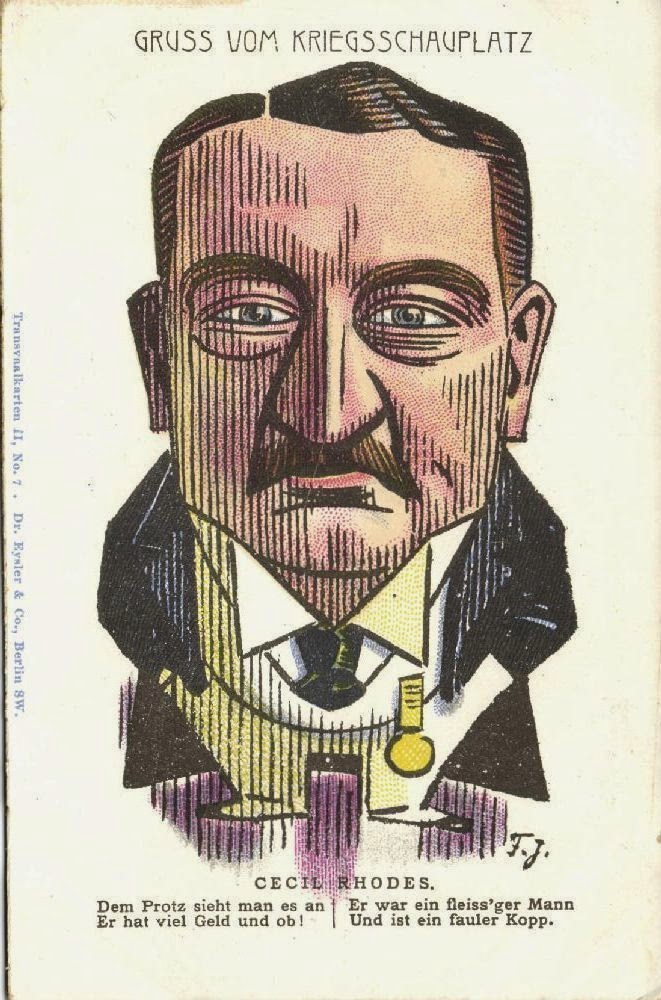
Cecil John Rhodes .
Cape to Cairo- Rhodes wanted it to be part of  the British Empire.
Cecil John Rhodes the prime minister of the Cape Colony was furious and instigated several attacks on the Boer Republics, but to no avail. In 1899 he got Chamberlain on his side and the Boer War started. It would last for three years and kill 26,000 women and children in their "scourged earth" policy to defeat the Boers.

Below are some photos and cartoons that were published all over the world as many people saw it for what it was-  a war by the British Empire to grab the riches of the Boer Republics.


Republic of the Orange Free State.


Republic of Transvaal.


The Boer Republics in Orange.


Paul Kruger. President of the Transvaal.


Young Boer Warriors.


Prisoners of War .Paardeberg..


General Koos De La Rey.


      Boers on Commando.


Boer Generals.


Generals De la Rey, De Wet and Botha.


Cecil John Rhodes Instigator.


The Devil is off to War.


Kruger and the British tin soldiers.


Tin soldiers captured.


Theater of War.


Bad news for Mr. Chamberlain.
 

John Buller tied down like Gulliver by the Transvaal and the Free State.

 
Kruger clobbering the Brits while Queen Vic looks on.


Kruger kicks the British out of Transvaal.


Paul Kruger and "Dogs of War".
 

John Buller telling the Boers to back off!


Boers waiting for the British Army in Natal.


Loosing a British Train.


Queen Victoria  giving her  soldiers chocolate while Kruger gives them hell.


Britannia consoling her people.


Kruger taking over England- as Caesar.


Buller before- Buller after....


Kruger cleaning up at Ladysmith.


Ladysmith has fallen.


John Bull is a little Boer-ed.


Kruger smacking the Khaki's


Queen Vic viewing her mules.


Theater of War. Queen Vic on stage.


England boiling in the sausage kettle.
Kruger and Father Christmas.


Kruger as a bull fighter.


President and Mrs. Kruger having a cup of coffee.


Death of Mrs. Kruger.
 

Mrs. Kruger in Heaven- Queen Victoria in Hell.


Lord Roberts and Kitchener.
 

David and Goliath- Buller fighting Kruger for the mountain of gold.


"Boer en Rooinek " game.


Boer head on a stick.


John Buller and Queen Victoria  in bed worrying about the Boer War. Paper Soldiers.
The Boer on the right on the mountain .
The English Lion being gaffed by Kruger the Bull.

Boer and Brit.


John Buller lost the key to Ladysmith.


Boer Family.


 Mother and children in the concentration camp .. 


Scorched Earth Policy.


Boer War concentration camps.


"A little  Transvaal Prisoner"


Concentration Camps for Boer Women and Children.  


Boer Concentration Camps.


"Stop the War"


Buller and Boer.
  

Boer War Death toll.

According top the Encyclopedia Britannica nearly 100,000 lives were lost, including those of more than 20,000 British troops and 14,000 Boer troops. Noncombatant deaths include the more than 26,000 Boer women and children estimated to have died in the concentration camps from malnutrition and disease; The total number of African deaths in the concentration camps was not recorded, but estimates range from 13,000 to 20,000.


War in Transvaal.


Paul Kruger on the "Gelderland" the ship the Queen Wilhelmina of the Netherlands sent to take him to Europe -and Switzerland where he died.


Tragedy of the Boer War.


Cecil Johan Rhodes with a bottle of Champagne while the Transvaal burns.


Transvaal and the Orange Free State on the pyre.


Cost of War.


Boer War. Asking Uncle Sam to help.


Read here about the American involvement in the  Boer War.